

LOG
Working Through Problems, Finding Possibilities
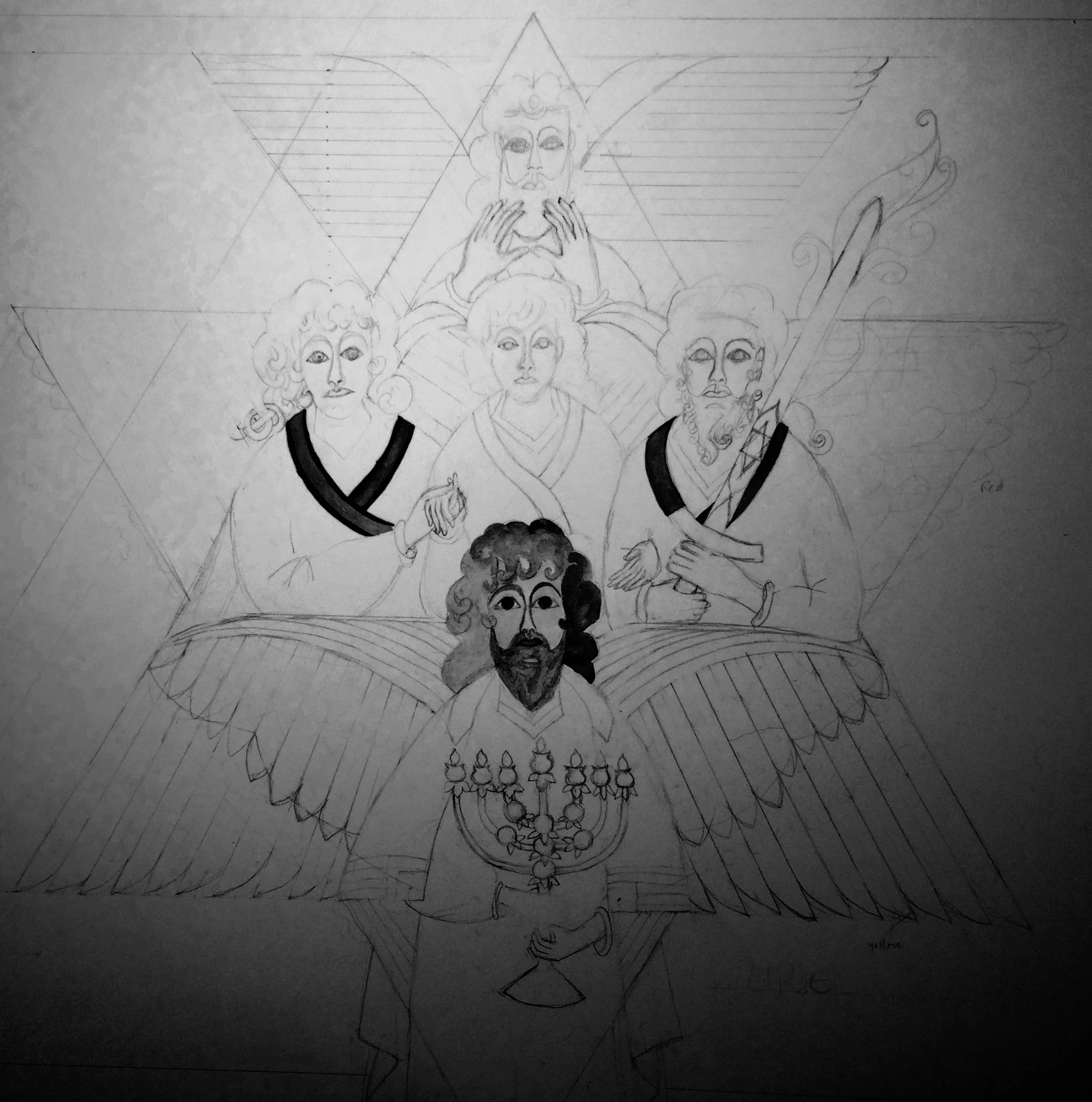
Imaginations have the wonderful property of not being bothered by too much detail. Once pencil is put to paper, the details must be "fleshed out." Exactly what are the angels' hands going to be DOING? Where can their wings fit into a Star of David? Should the feathers be flowing outward, or downward? How real does all this have to be, or can it be fanciful? As you can see, countless questions present themselves.
Imaginations have the wonderful property of not being bothered by too much detail. Once pencil is put to paper, the details must be "fleshed out." Exactly what are the angels' hands going to be DOING? Where can their wings fit into a Star of David? Should the feathers be flowing outward, or downward? How real does all this have to be, or can it be fanciful? As you can see, countless questions present themselves.
Regarding the angels' hands: each became the possibility for a symbol. Uriel is the guiding light of God. What is the Jewish symbol for light? The Ner Tamid of the ancient temple, the seven branched menorah. The Torah gives a detailed, and at the same time puzzling description of how it is to be made. For centuries artists have tried to depict this special menorah. The Torah uses botanical language to describe a "calyx" or cup that holds the wicks and olive oil, and where these calyxes are to be placed. It occurred to me, that the circles I was drawing to make the cups might be seen as the sephirot of the mystics. The sephirot are a concept that entered Judaism much later than the Torah, but central to the rich mix our culture has become. I chose to embed the sephirot subtley into the menorah for those who might see it.
Michael accompanies, symbolized by his holding of the hand of the figure in the center of the painting. Gabriel, of course, has a flaming sword, "turning this way and that" (I chose not to depict the "turning" as that wouldn't fit a 9th C style.) But what about Raphael? How can I show him as healing? I chose to depict him as raising his hands in the priestly blessing, like Aaron the high priest who issues forth from the Holy of Holies to bless the people. The questions of how to make the hands became portals to new understandings about the angels. The artwork had taken on a life of its own, and it began to teach me.
Drawing the First Draft
even God was disappointed with his first draft in creating the world,
When the drawing actually begins, one is in for a big adventure. It never turns out like what I imagine. Problems emerge. I remind myself that even God was disappointed with his first draft in creating the world, and wanted to destroy all of mankind. But along with the disappointments and problems, possibilities open up as well. For example, God made a plan: to save a remnant, namely Noah & his family.
I needed some plans, too. How would I place the angels? "Wings....hmmmm...How might the wings work in my own composition? The thought came to me that the wings might form a Jewish Star. Does the Book of Kells draw the feathers sideways? Or up? Or down?

The fact that each angel has a mission led me to wondering how I might symbolize their tasks in the painting. Gabriel was easy, as he has a flaming sword. Michael holds one's hand. And Raphael, how might I symbolize his healing from behind? I saw him with his hands raised in blessing, and then I thought of the priestly blessing---he could hold his hands like the Aharonites. Uriel, God's guiding light. What is a symbol of light in Jewish tradition?..... of course, the menorah in the ancient temple! As I began to draw Uriel's lamp, referring back to the Bibilcal passage with instructions for its manufacture, it occurred to me that it could look somewhat like the Kabbalistic Sephirot. That became a little secret in the painting, for those whose eyes might catch it.
Speaking of Angels...
I had been immersed in angels for a few weeks---painting the Four Angels, giving a talk at a Lunch and Learn, presenting a ritual for summoning the angels at the Chevra Kadisha conference in Lexington; but then, there came a day when one showed up on my doorstep...
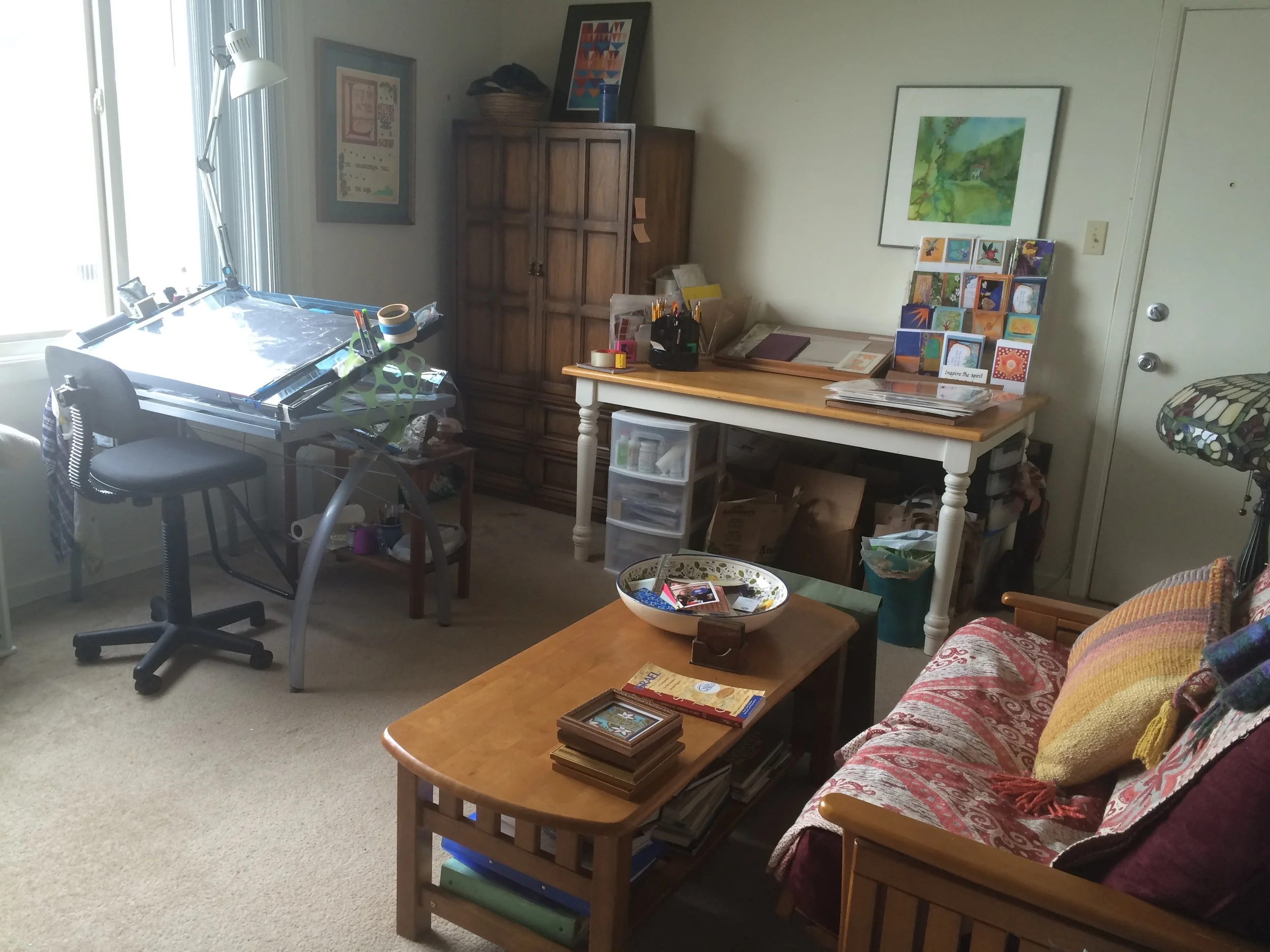
In case you hadn't picked up on it, I am making a transition in my life to becoming a full time artist-rabbi. That meant that I had make my little art table* in my home to something more expansive---a studio, where I might feel the invitation to work at on a daily basis. I live in a small apartment in San Francisco, and that meant the only option was to turn my living room into an art studio. Instead of paintings piled up in corners, willy nilly, instead of piles of cardboard boxes, being saved for transporting paintings, I needed some kind of rack. Instead of a makeshift table with piles of art supplies, I needed some sort of organization.
At my birthday a couple of months previous, I asked friends not for gifts, but to help me reorganize my space for my new life. My friend Margo, the "handywoman," obtained some bookshelves to remodel into racks, but first, I would need to get rid of a very large, double futon to make space.
In using a neighborhood website to offer the futon, I found an armoire I really coveted, with drawers and cubbies to hold my stuff. The futon moved out, and finally, the day arrived in which Margo and another friend, Elliot, who made me a birthday pledge, were scheduled to bring the bookshelves. I ordered dinner delivered that day, as I had a pressing engagement late in the afternoon, and the only window of time the delivery man could come was right when Margo and Elliot would be there. I thought to myself, "This will be chaotic, but I have no other choice."
I cleared out the cardboard boxes from the corner, set aside the paintings to make room for the bookshelves. Margo and Elliot grunted and groaned and moved the shelves up the stairs and into place; they proved to serve their purpose beautifully. Margo and Elliot sat down for a cool drink, and I mentioned the armoire. (I had gone to take a look at it, and given the owner a check.) Because they are terrific people, (angels you might say) and because Margo was borrowing a pickup for the day, they said "why not?" and went to fetch it. This, despite their exhaustion, and Margo's date with her husband pressing upon her. They told me to stay home and clear out another corner of the living room, and set off to get the armoire. It was close by...just 15 minutes away.
20 minutes later, Elliot calls me and says they will need another person to get that heavy thing up the stairs to my apartment. Did I know anyone I could call? Frankly, I didn't know any young strong folks near by. They were 10 minutes away! My sister had used Task Rabbit once and was very pleased, so I downloaded the app, and began entering a request, which was going to cost me $60+. Oh Well. That's what comes from spontaneous non-planning. I heard Margo and Elliot's pick-up pulling up as I was anxiously trying to enter my credit card details into task rabbit. The app was telling me I had the wrong CV code on my credit card. I didn't. "OK, try a different credit card." They were out of the truck, unloading the armoire onto the sidewalk. The app was telling me my zip code was incorrect. It wasn't. I was frantic. I ran out the door to talk with them...and a my phone alerted me that a text had come in. The meal delivery man, Mohammed, was arriving shortly.
I ran down the stairs, and the delivery man, a young, strong, man, on his way up, Margo and Elliot and the armoire on the sidewalk.
"Listen," I said to Mohammed. "I'm going to ask you something a little strange, and I will pay you, and you can say no, but would you be willing to help my friends move this piece of furniture into my apartment?" "I'm happy to pay you," I repeated. He looked at me seriously. "Oh, You know, were aren't supposed to do things like that....but sure! I'll help you!"
The relief I felt was enormous...but the best part is yet to come! I heard them grunting and groaning up the stairs...Margo saying, "Oh my grip is slipping! we have to set it down..." The armoire and its carriers rounded the bend through the front door, into its new corner, and there were great sighs all the way round.
I ran to get a $20 bill and tried to hand it to Mohammed. "No, no," he brushed my hand away. I swear I tried three times, and he would have none of it.
"Well if he won't take any money, give him a blessing!" Margo belted out. I turned to him. "I'm a rabbi. Would you like a blessing?" "Sure!" he said. "I'll take a blessing!" I reached our for his hands, and with Margo on one side, and Elliot on the other, as witnesses, I blessed this angel who showed up at the precise moment of our need, for his great generosity...that this generosity be returned to him and for generations of his children after him, for his kindness and thoughtfulness and open spirit, that he have health, strength and a long life...." Margo and Elliot exclaimed "AMEN," Then the angel dropped off the meal, and left.
*The little art table is a fantastic tool, given to me by my son Noah some years previous.


Style as a Choice
"This is my model! This is the container for my idea!"
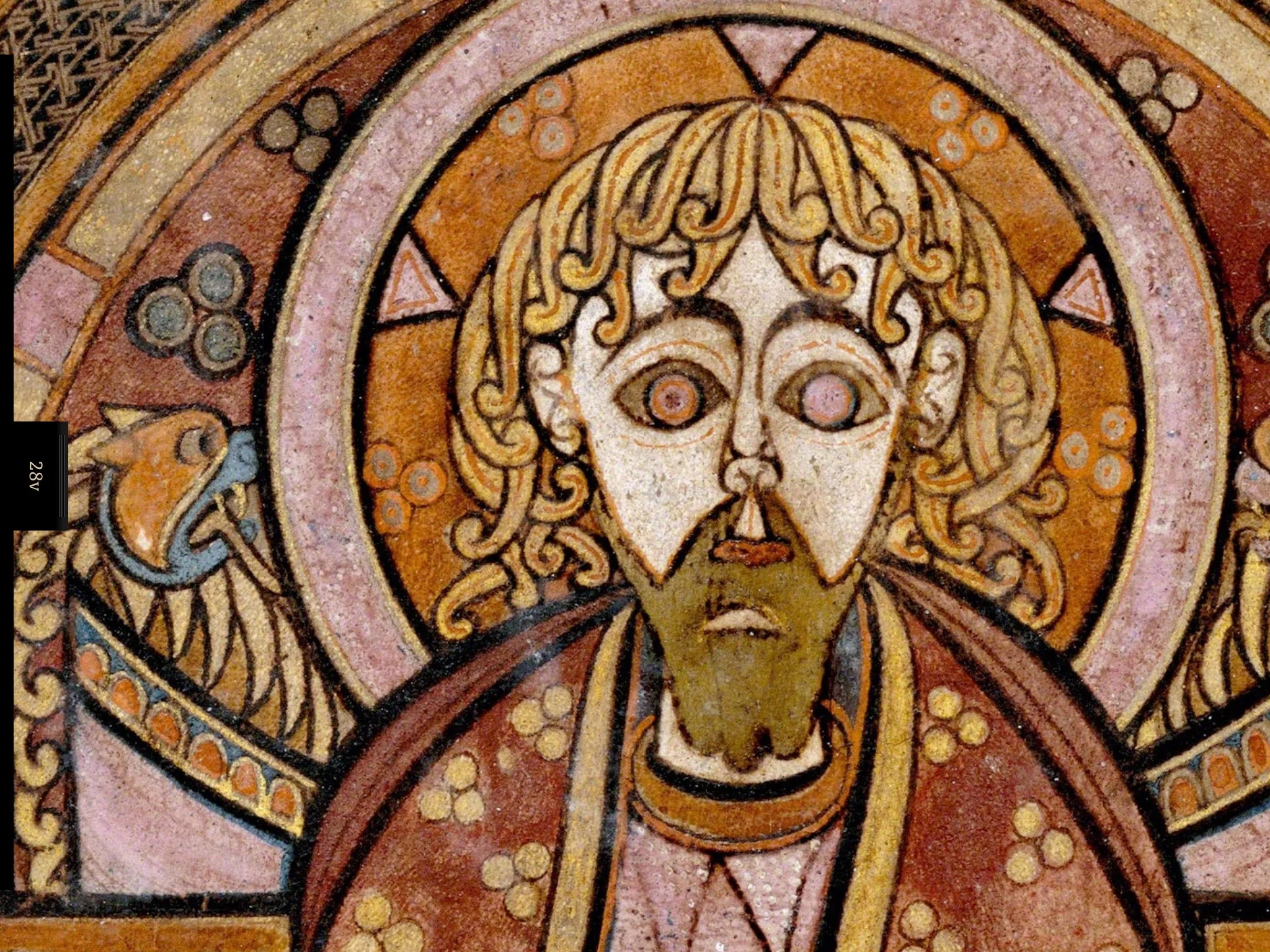
The Book of Kells is one of the all time great illuminated manuscripts. It has come down to us from the beginning of the 8th C. It is replete with enchanting people and animals engaged in all sorts of shenanigans. It has a decorative style in keeping with my own. When I was looking at it on my iPad app one day, I realized, "This is my model! This is the container for my idea!" I was immediately able to see images of the four angels with those wide eyes, poker faces yet totally engaging expressions, curling manes of hair, long thin fingers, in variously colored and patterned garments. I did not have to be well versed in anatomy to draw these figures. But I did need to study the style more closely...
Questions arose: How are their faces drawn? In what way does the body show underneath the clothing? How are folds in the garment depicted? How do their hands 'hold' items? Did their wings look like bird wings? These questions took me back again and again to studying the book. I tried some preliminary drawings. For these sketches, I use a program called "Paper by 53" on my iPad.

Here is one of the preliminatry sketches. He looks to me (if I may be so grandiose) to be the Book of Kells meeting Picasso!
But now, I had what I needed to enter into the next Kabbalistic "world:" the realm of Formation---picking up the medium and beginning to acutally form the work!
Next: "Drawing the First Draft."
In the Mind's Eye
What do I see?
I had a lot of difficulty imagining drawing these angels. Seeing them in the "mind's eye" is one thing, but drawing what I see--that is another. Would they be flying around? Encircling? Standing?
I tried doing a drawing of this once for a dying man, and while it comforted the family, I did not like the drawing. That was years ago, and I had been stymied since then as to how to represent the concept that we are constantly surrounded by angels.
The paradigm places them: Michael on the right, Gavriel on the left, Uriel before us, Raphael behind, and the Holy Presence above. I have experienced them: Michael's support, Gavriel helping me prioritize, Uriel lighting the way forward when I felt I didn't know where I was going, and Raphael closing up wounds, smoothing, healing as time passed. The Holy Presence feels further away than the angels, but again, if I put my intention into it, I can experience The light from above.
Yes, I was stuck. But in the meantime, singing about these angels at the bedside of many an ill or dying person, they became close friends, and I witnessed the healing power the concept had on the families and the persons in need of support. I tried drawing them a few times, but was never satisfied with the result.
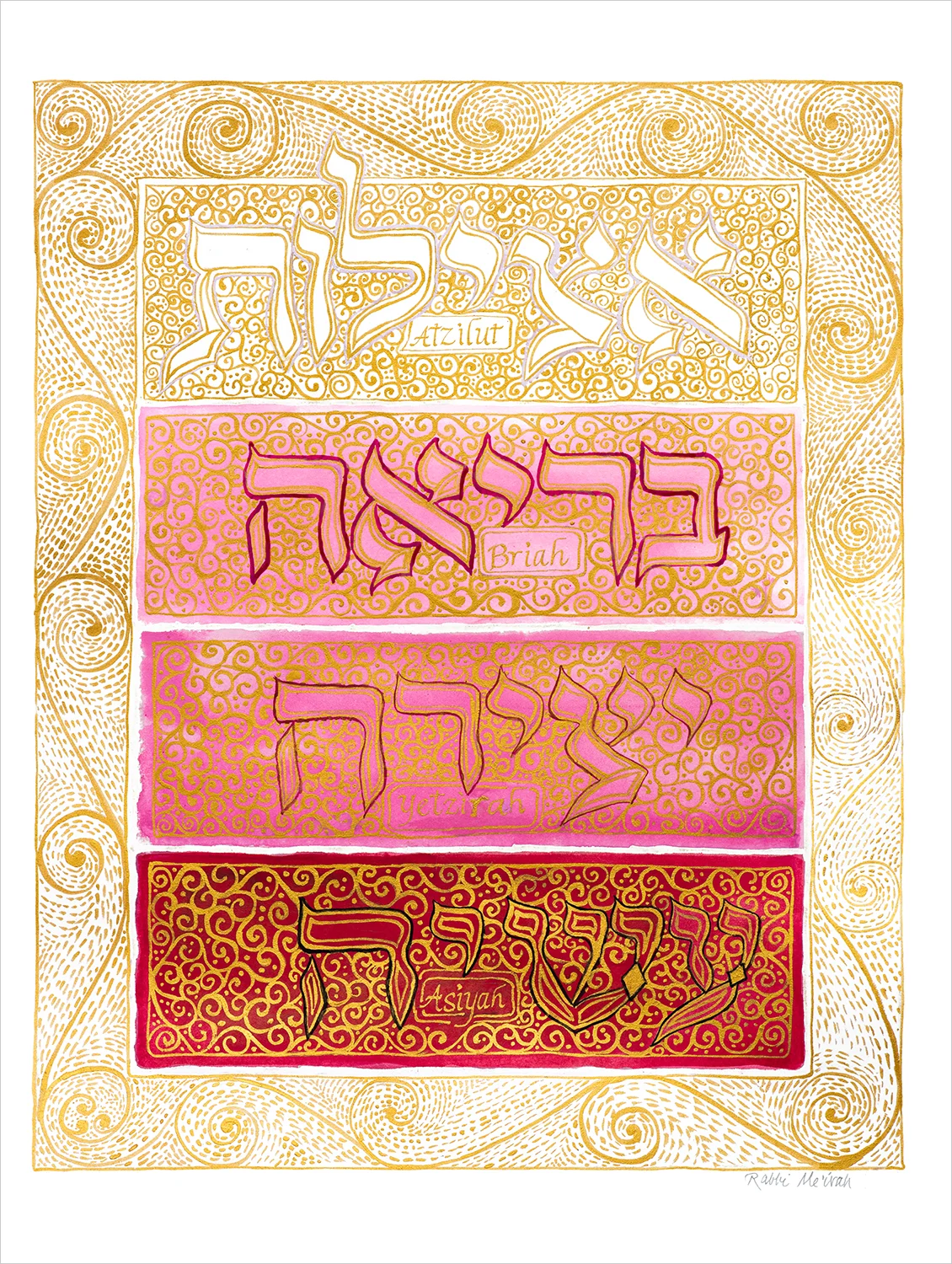
If I think of the artistic process through the lens of the "Four Worlds" in Kabbalistic thought, I was now swimming in the world of Briyah, Creation, where a concept is still vague. That is the uppermost pink realm in this painting.The idea needed fermenting in order to descend closer to this tangible world.. Next: "Style as a Choice."

Moving from Concept to Actuality
What is the artist's process from the "ahah moment" of an idea, to making it into a work of art?

What is the artist's process from the "ahah moment" of an idea, to making it into a work of art? In this series of blogs, I want to take you with me on this journey.
I think of this process as channeling something from "the Beyond." How can I bring the idea into this physical world, and work with it, until it takes on a life of its own?
In the beginning of Genesis, I think of God as the consummate Artist. God's medium is all the matter of Creation, before it is even matter! In Hebrew, the verb "to create" (lavrie, or bara) can only have God as the subject, because it means to make something from nothing.
For us human artists, the Hebrew word: l'hagshim is more fitting. It means to realize, carry out, effect, execute. What's so inviting about this word? It comes from the root geshem, rain. Therefore it conjures up all that makes a bit of dust become a raindrop and "fall" into our world: moisture slowly condensing until it is significant enough, heavy enough, to drop into our presence. So the "aha" is like the dust mote, and then, I need to collect the thoughts of "moisture" that will bring the idea down to earth.
Here is the process I went through with my painting of "The Four Angels."
There is a compelling piece of liturgical poetry in our bedtime prayers. It gives voice to an idea, that If you speak the prayer, it can move from an idea to an experience:
"In the name of Adonai, the Holy One of Israel, on my right is Michael, on my left is Gavriel, before me Uriel, behind me Raphael, and up above, the Holy Shechinah."
Michael, whose name means "Who is like God," to hold one's hand in order to accompany, so that you might not be alone;
Gabriel, "the Power of God," with his flaming sword, to cut out the detritus in one's life;
Uriel, "the Light of God," to illuminate one's path forward, even if that be only one step at a time.
Raphael, "the Healing of God" who binds up the wounds, spiritual or physical, cleaning up the trail,
and Shechinah, the felt experience of the Divine Presence hovering overhead.
Melodies have made this quote into a singing meditation very useful when people are at their most vulnerable: very ill, dying, or in mourning.
Inevitably, when I have sung this prayer, if the person is conscious, they nod in understanding. I have been told by a relative that she believed this meditation helped her mother release her suffering struggle and die.
I felt I needed to make an illumination to keep this vision present; a reminder that we are, at all times, surrounded by angels. Next: "In the Mind's Eye."